
Your Traffic is Dropping. Here’s How to Rank in Google’s "AI Mode."
Short Description: The "Blue Links" are dead. Google's new AI Overviews are stealing your traffic. Discover the strategies behind GEO (Generative Engine Optimization) and how we helped an Automotive brand recover 40% of their lost traffic by becoming the "cited source."
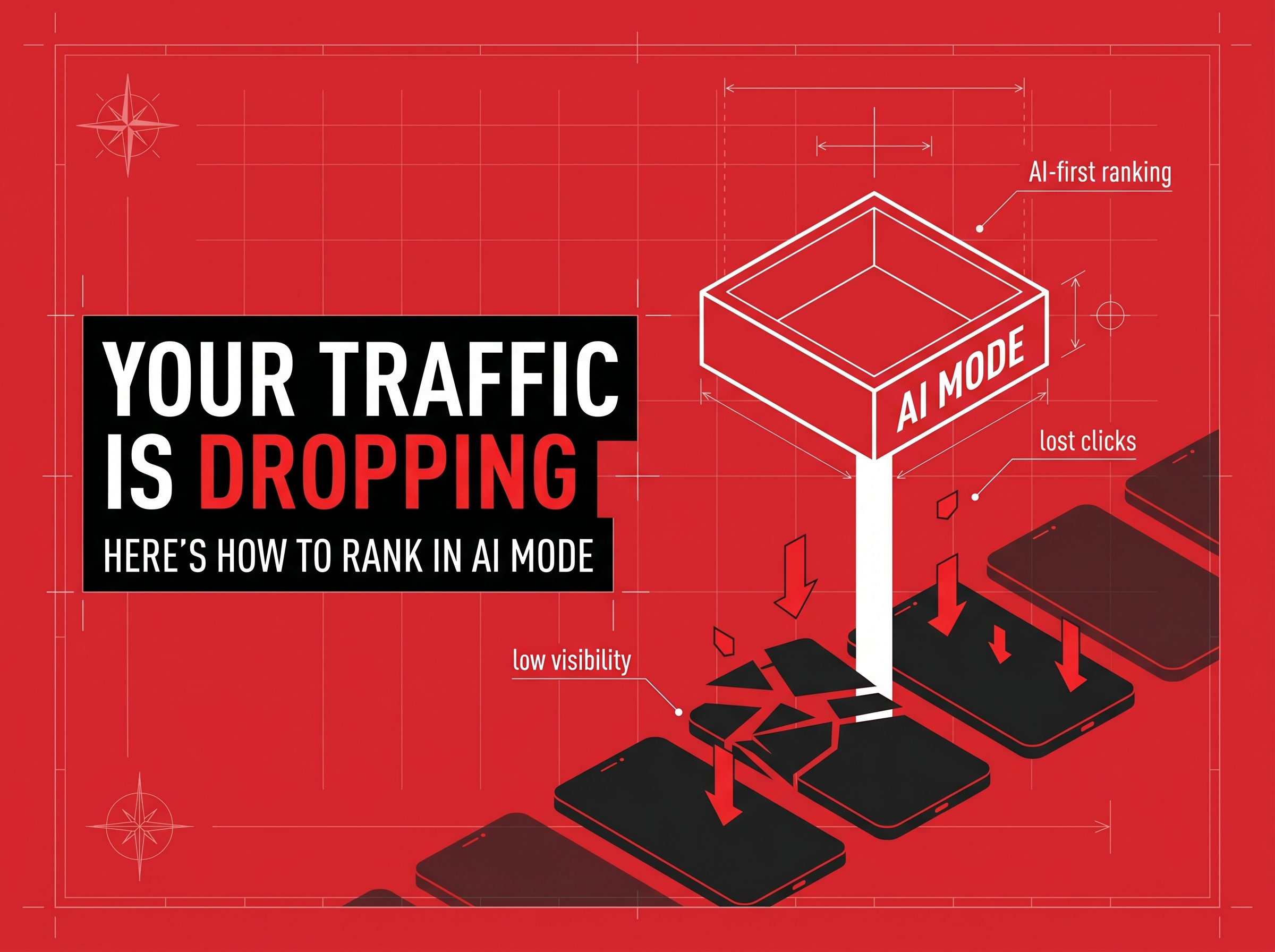
Your Traffic is Dropping. Here’s How to Rank in Google’s "AI Mode."
The "Zero-Click" Panic
Have you noticed something terrifying in your analytics? Your keyword rankings are stable. You are still sitting at Position #1 or #2. But your click-through rate (traffic) is plummeting.
Why? Because Google has changed the layout of the internet. With the rollout of Google AI Overviews, the top of the search result is no longer a list of links. It is a generated Answer. Google is no longer sending users to your website to find the answer. It is reading your website, summarizing it, and giving the answer to the user directly.
If you are not the source Google cites in that AI box, you are invisible. Here is how to survive the era of “Zero-Click Search.”
ROCKPAPER RUNWAY Case-Study: The "Invisible" Automotive Giant
We recently diagnosed this exact issue for a major Automotive Client.
The Problem: They were ranking #1 for their core keywords (e.g., "Best SUV for families 2025"). On paper, they were winning. In reality, their organic traffic had dropped by 40%. The Cause: Google's AI was answering the question "What is the safest SUV?" right on the search page. Users read the answer and never clicked the link.
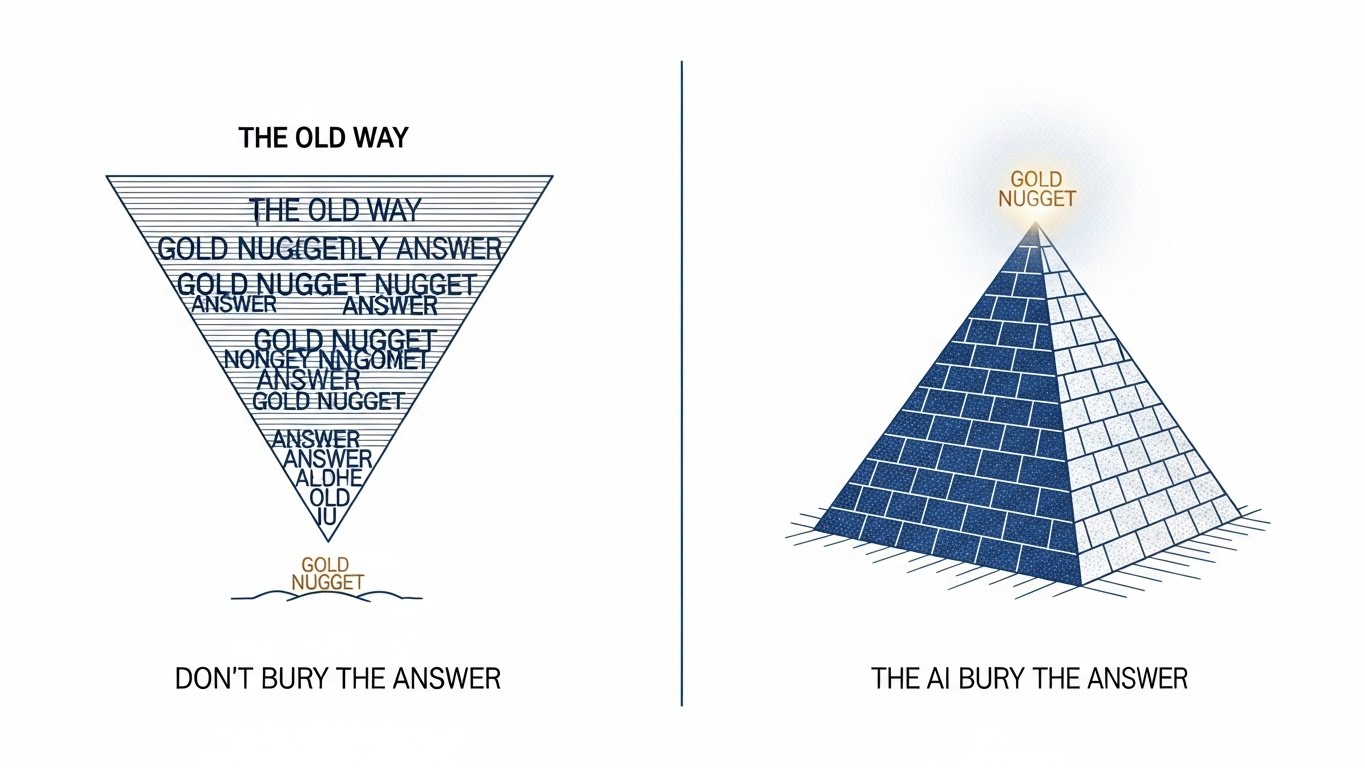
The Fix (The Inverse Pyramid): We realized their content started with 300 words of "fluff" intro. The AI couldn't find the answer easily, so it cited a competitor who was more direct. We rewrote their product pages using the Inverse Pyramid strategy (explained below). We moved the core value proposition ("5-Star Safety Rating, 7 Seats") to the very first sentence.
The Result: Within 2 weeks, Google’s AI started citing our client as the primary source of the answer. The traffic didn't just return; the quality of traffic improved because users were clicking to "verify" the AI's claim.
Strategy 1: The "Inverse Pyramid" Writing Style
In 2020, we wrote long introductions to keep users on the page. In 2026, that kills your chances of AI ranking. You must write like a journalist: The Answer First.
Bad (Old SEO):
"When considering the optimal vehicle for safety, there are many factors families should consider, such as airbags and braking distance..." (The AI skips this).
Good (GEO Strategy):
"The safest family SUV in 2026 is the [Model X] because it is the only vehicle with a 5-Star Crash Rating and automated emergency braking standard." (The AI cites this).
The Action: Audit your top 10 pages. Move the direct answer to the very top (First 50 words).
Strategy 2: Become an "Entity," Not Just a Website
Google's AI relies on a "Knowledge Graph." It maps connections between things. It needs to know that [Your Brand] is an entity associated with [Your Industry].
How do you teach it?
- Digital PR: You need citations on "Seed Sites" (Wikipedia, Crunchbase, Clutch, UpCity).
- Structured Data (Schema): You must use code to tell Google exactly who you are.
- Don't just write: "We are an agency."
- Code it: <Organization type="Corporation" sameAs="linkedin/yourbrand">
If the AI doesn't know who you are, it won't quote you.
Strategy 3: Win the "Long-Tail" to Win the Broad
You cannot win the broad term "Best Development Agency" immediately against giants like Accenture or Toptal. The Fix: Win the Long-Tail first. AI builds trust from the bottom up.
- Rank for "Best React Native Agency for Fintech."
- Rank for "Best Fintech App Developers."
Eventually, the AI learns: "This brand is consistently the best for development." You don't start by boiling the ocean. You start by owning the specific questions your customers ask before they type the generic one.
How ROCKPAPER RUNWAY Optimizes for GEO
We don't fight the algorithm; we feed it.
- Content Restructuring: We rewrite your core pages to be "Machine Readable," placing direct answers in Schema markup.
- Authority Building: We execute Digital PR campaigns to get your brand mentioned in the sources Google's AI trusts (Clutch, G2, TechCrunch).
- Data Defense: We monitor which keywords trigger AI Overviews and adjust your strategy to ensure you are the cited source.
Is your brand invisible in AI Mode? Contact us for a GEO (Generative Engine Optimization) Audit. We will check if Google's AI trusts your brand. [Get Your GEO Audit →]
FAQ
Q: Can I opt out of Google AI Overviews? A: Technically yes, by using "nosnippet" tags, but we strongly advise against it. Opting out means you disappear from the most valuable real estate on the search results page.
Q: Does word count still matter? A: Less than before. "Depth" matters, but "Length" does not. A 500-word article that answers the question perfectly is more likely to be cited by AI than a 3,000-word article full of fluff.
Q: How do I rank for "Best Agency" if I am small? A: Focus on "Third-Party Consensus." Google's AI looks at reviews on Clutch, G2, and UpCity. If you have high ratings there, the AI is more likely to cite you as a "Best" option, even if your own website has lower traffic.
Key Takeaways
- ✓We are moving from SEO (Search Engine Optimization) to GEO (Generative Engine Optimization).
- ✓Be the Source: Google's AI prioritizes content that is fact-dense, authoritative, and easy to summarize.
- ✓The "Inverse Pyramid": To get picked up, your content must directly answer the user's question in the first 50 words (BLUF - Bottom Line Up Front).
- ✓The Lesson: As our Automotive Client proved, you can't force users to click, but you can force Google to cite you.

Discussion
Be the first to start the conversation.
Leave a Comment