
Flutter vs. React Native in 2026: The CTO’s Guide to Performance & ROI
"Choosing the wrong mobile framework can cost you six figures in technical debt. We break down the ultimate Flutter vs. React Native showdown for 2026, comparing performance, hiring costs, and long-term ROI."
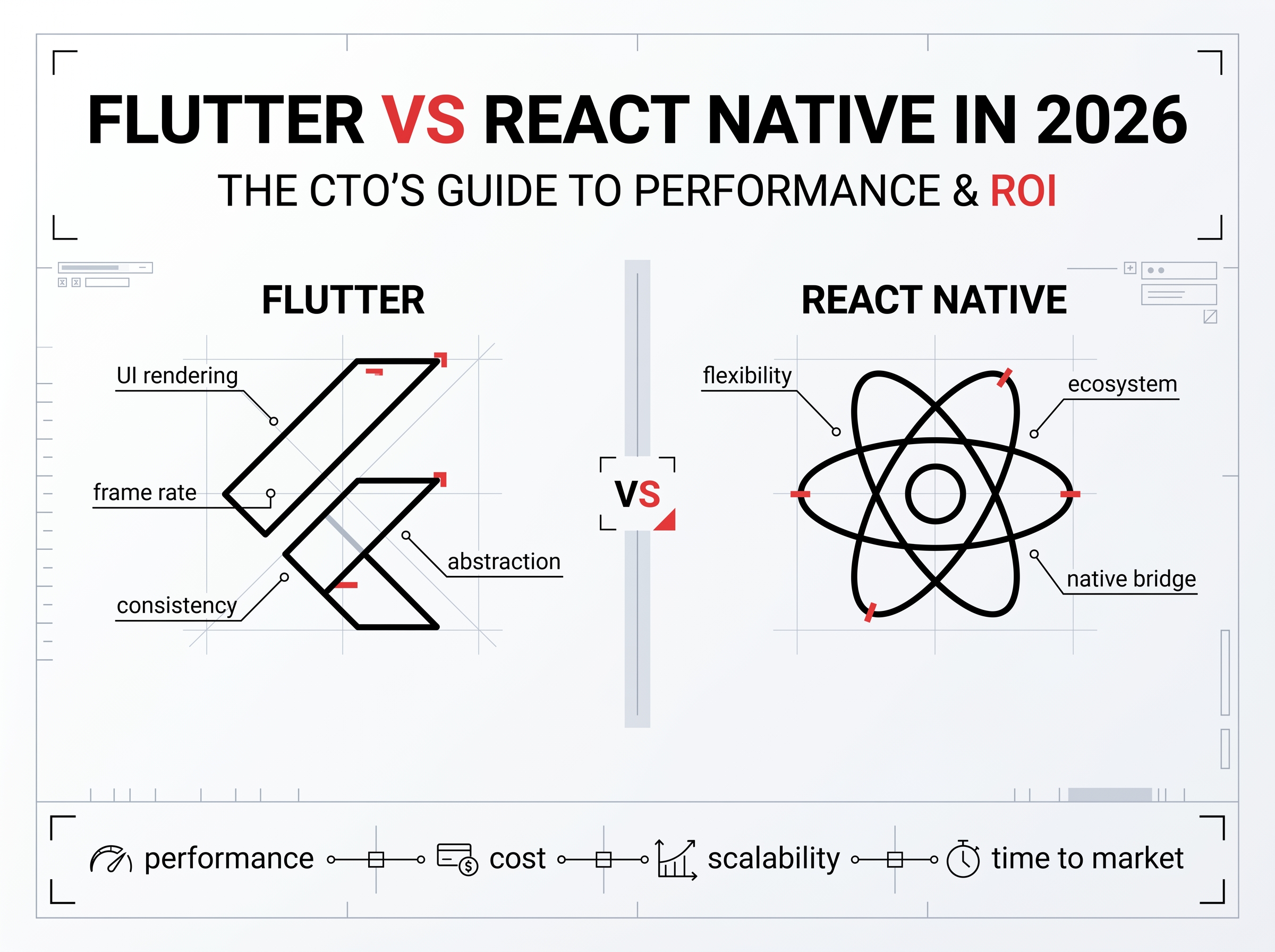
Flutter vs. React Native in 2026: The CTO’s Guide to Performance & ROI
Choosing between Flutter and React Native isn’t just a technical preference in 2026—it’s a business strategy. With app development costs rising and the demand for "native-like" performance non-negotiable, picking the wrong framework can cost you six figures in refactoring later.
Whether you are a startup looking for a rapid MVP or an enterprise scaling a Superapp, the debate has evolved. It is no longer just about "which is easier to code." It is about Performance, Hiring Strategy, and Platform Stability.
At ROCKPAPER RUNWAY, we build on both. But the right choice depends entirely on your specific business goals. Here is the definitive breakdown for 2026.
💡 Key Takeaways
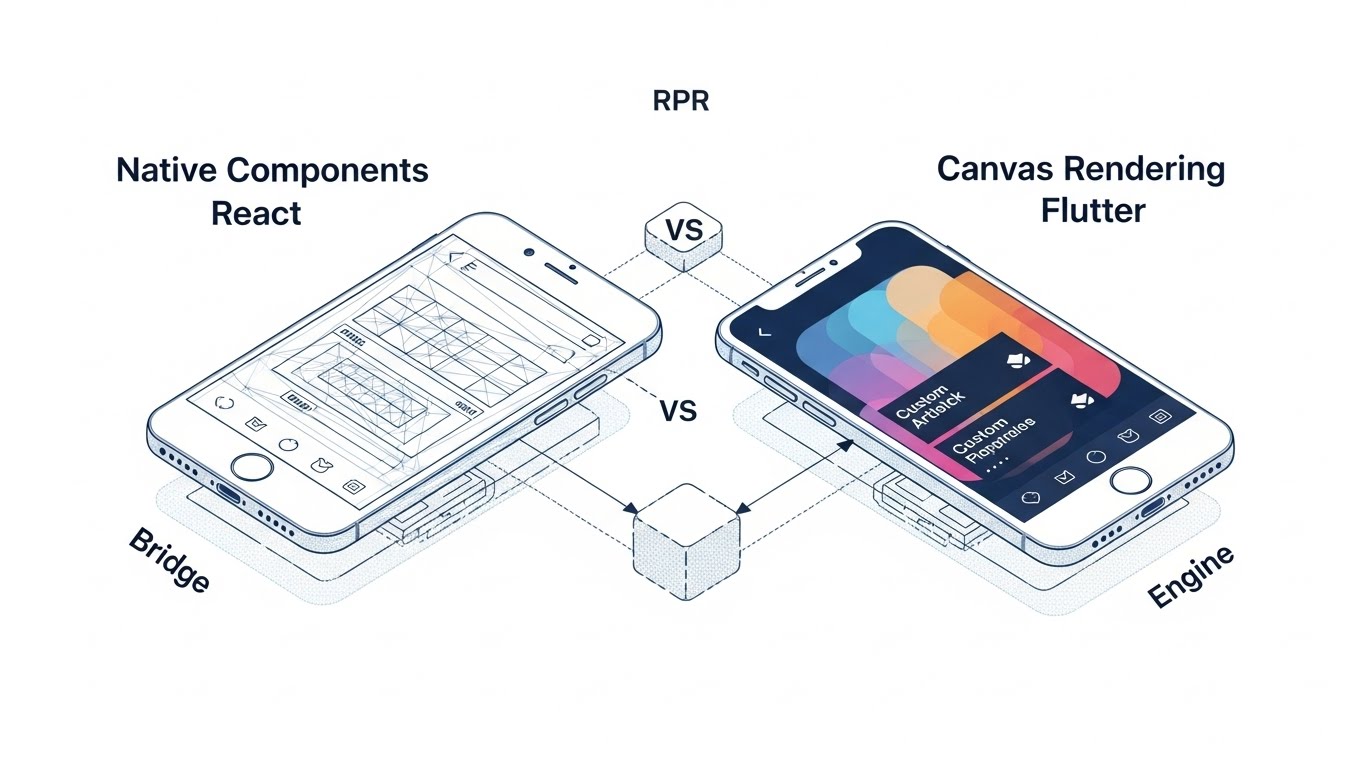
- The Core Difference: React Native uses a "bridge" to talk to native components (great for relying on native look-and-feel). Flutter draws its own pixels on a "canvas" (great for custom, brand-heavy designs).
- Performance 2026: Flutter’s "Impeller" engine has largely solved early "jank" issues, offering consistently higher frame rates (120fps) on complex animations compared to React Native.
- Hiring Strategy: React Native developers are easier to find (JavaScript ecosystem). Flutter developers are more niche but often more specialized in mobile UI.
- The ROI: React Native is often faster for teams with existing web products. Flutter is often faster for greenfield projects requiring consistent UI across iOS and Android.
1. The Architecture: Bridge vs. Canvas
To make a decision, you must understand how they work under the hood.
React Native (The Bridge)
React Native (by Meta) renders a user interface that is truly native. It uses a JavaScript "bridge" to communicate with the iOS or Android platform.
- Pros: If Apple updates a button style, your app updates automatically. It feels exactly like a standard iPhone app.
- Cons: The "bridge" can become a bottleneck during heavy calculations, causing slight lag in complex apps.
Flutter (The Canvas)
Flutter (by Google) works like a game engine. It doesn't use the phone's native buttons; it draws every single pixel itself using the Skia (and now Impeller) rendering engine.
- Pros: Total control. Your app looks exactly the same on an old Android as it does on a new iPhone. It is pixel-perfect by default.
- Cons: The app size is slightly larger because it bundles its own rendering engine.
2. Performance Showdown: The "Impeller" Update
For years, React Native had the edge in stability, and Flutter had the edge in speed. In 2026, the gap has narrowed, but distinctions remain.
Flutter’s Ace:
The rollout of the Impeller rendering engine has been a game-changer. It pre-compiles shaders, meaning the "first-run stutter" that used to plague Flutter apps is gone. For apps requiring complex animations, heavy graphics, or custom UI transitions, Flutter is currently the performance king.
React Native’s Response:
React Native’s "New Architecture" (Fabric) has removed much of the reliance on the old "bridge," allowing for synchronous communication. It is faster than it used to be, but for heavy graphical lifting, it still trails slightly behind Flutter’s raw rendering power.
3. The Talent Pool: JavaScript vs. Dart
This is often the deciding factor for CTOs.
- Choose React Native if: You already have a web team. React Native uses JavaScript (React). If your team knows React.js for the web, they can be productive in React Native in two weeks. The talent pool is massive.
- Choose Flutter if: You are willing to hire specialists. Flutter uses Dart, a language created by Google. It is easy to learn, but you can't just throw a web developer at it and expect instant results. You are hiring "Mobile Developers," not "Web Developers who do mobile."
4. The Decision Matrix
| Feature | Flutter | React Native |
|---|---|---|
| Performance | ⭐⭐⭐⭐⭐ (Consistent 120fps) | ⭐⭐⭐⭐ (Very Good) |
| UI Consistency | ⭐⭐⭐⭐⭐ (Pixel Perfect everywhere) | ⭐⭐⭐⭐ (Platform Adaptive) |
| Hiring Speed | ⭐⭐⭐ (Niche Talent) | ⭐⭐⭐⭐⭐ (Abundant Talent) |
| Dev Experience | ⭐⭐⭐⭐⭐ (Great tooling/docs) | ⭐⭐⭐⭐ (Can be fragile) |
| Best For... | Brand-heavy, custom UI apps | Data-heavy, utility apps |
How ROCKPAPER RUNWAY Builds World-Class Apps
Building the app is just step one. Ensuring it ranks, converts, and scales is where we come in.
At ROCKPAPER RUNWAY, we don't just write code; we engineer products:
- App Development: Whether you choose Flutter or React Native, our senior engineers build scalable, clean architecture that minimizes technical debt.
- Design: Our UI/UX team understands the nuance of Human Interface Guidelines (iOS) vs. Material Design (Android), ensuring your app feels premium.
- QA Testing: We employ rigorous automated testing (using tools like Detox for RN or Integration Tests for Flutter) to ensure your app doesn't crash on launch.
- Performance Marketing: Once live, we run App Store Optimization (ASO) and paid acquisition campaigns to drive high-LTV user installs.
Stuck at the crossroads?
Don't guess with your tech stack. Contact ROCKPAPER RUNWAY for a comprehensive architecture audit. We will help you choose the right framework for your business goals, not just the trends.
[Book Your App Architecture Consult →]
Frequently Asked Questions (FAQ)
Q: Is Flutter dying in 2026?
A: No. While Google has laid off some staff, the Flutter open-source community is larger than ever. With the release of the Impeller engine, Google has doubled down on Flutter's technical future, expanding it to embedded devices and desktop apps.
Q: Which is cheaper to build: Flutter or React Native?
A: Development speed is comparable. However, Flutter can sometimes be faster for the initial build (MVP) because its widget library is pre-built and styling is faster. React Native may be cheaper long-term if you already have a JavaScript team to maintain it.
Q: Can I switch from React Native to Flutter later?
A: You can, but it is a complete rewrite. There is no automated migration tool. This is why choosing the right architecture before you write line one is critical.
Key Takeaways
- ✓The Core Difference: React Native uses a "bridge" to talk to native components (great for relying on native look-and-feel). Flutter draws its own pixels on a "canvas" (great for custom, brand-heavy designs).
- ✓Performance 2026: Flutter’s "Impeller" engine has largely solved early "jank" issues, offering consistently higher frame rates (120fps) on complex animations compared to React Native.
- ✓Hiring Strategy: React Native developers are easier to find (JavaScript ecosystem). Flutter developers are more niche but often more specialized in mobile UI.
- ✓The ROI: React Native is often faster for teams with existing web products. Flutter is often faster for greenfield projects requiring consistent UI across iOS and Android.


Discussion
Be the first to start the conversation.
Leave a Comment