
50% of Your Visitors Are Robots. Is Your Website Blocking Them?
If ChatGPT can't read your website, you don't exist. Discover the "Agent-Ready Web" how to build infrastructure (like llms.txt and Schema) that invites AI Agents to visit, read, and buy from you.
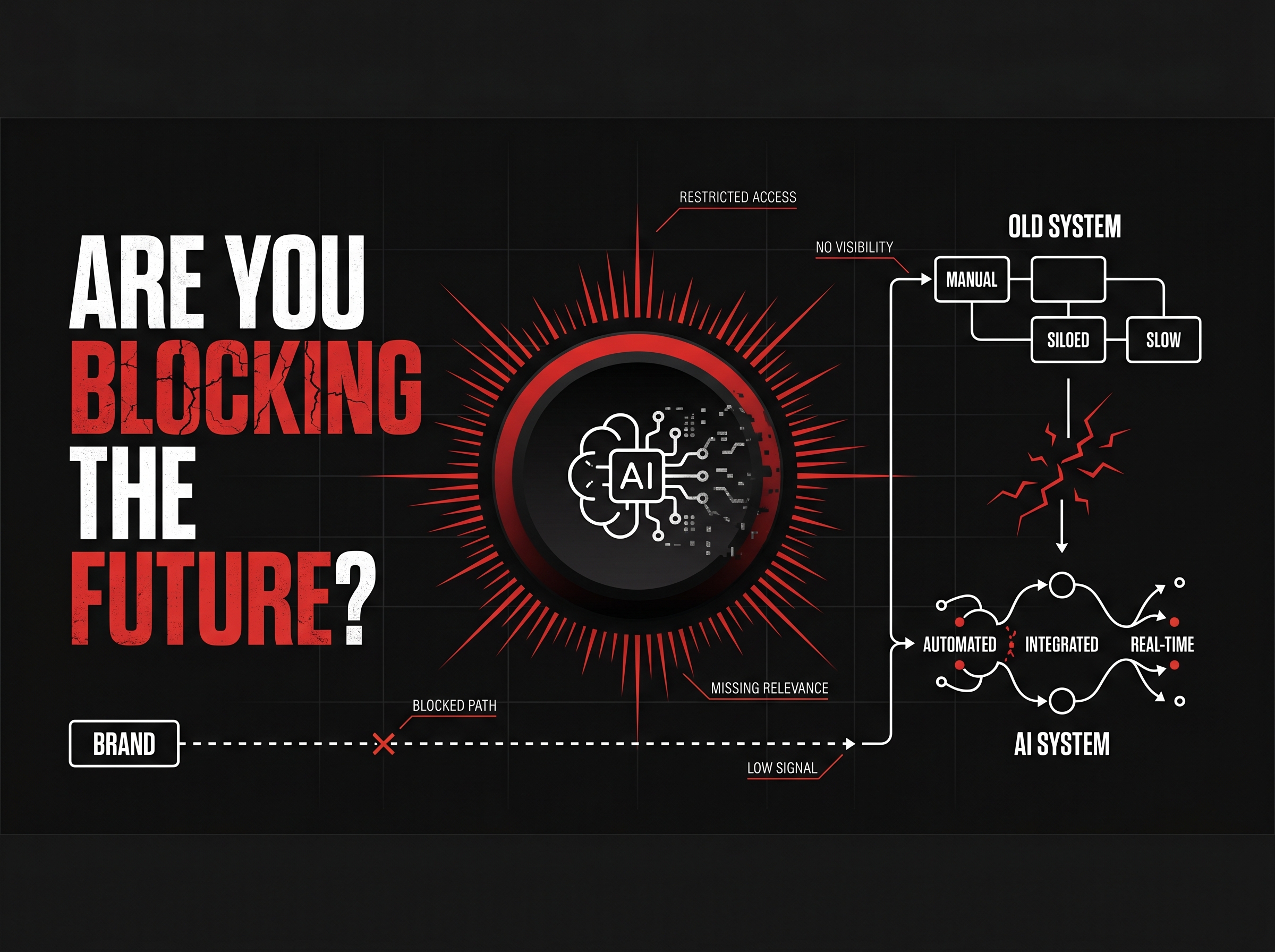
50% of Your Visitors Are Robots. Is Your Website Blocking Them?
The "Invisible" User
We have spent the last 30 years building websites for humans. We obsessed over font sizes, button colors, and "above the fold" content.
In 2026, a new type of user has arrived. They don't care about your colors. They don't scroll. They don't have eyes. They are AI Agents.
When a user asks ChatGPT, "Find me a CRM software that integrates with WhatsApp and show me the pricing," the AI acts as an Agent. It visits your site, reads your code, and tries to extract an answer. If your website is built on legacy tech with bloated JavaScript, the Agent hits a wall. It can't read your pricing. It can't find the feature list. So it leaves, and goes to your competitor who has an Agent-Ready Architecture.
Welcome to the Invisible Web. If you aren't building for it, you are losing the fastest-growing segment of traffic on the internet.
Agency Case Study: The "Restoration" of a SaaS Unicorn
We recently deployed this architecture for a SaaS company based in India.
The Problem: They rolled out a major pricing update, but for weeks, AI tools (like Perplexity and Gemini) kept quoting their old 2024 pricing to potential customers. The AI "cache" was stuck because their website was too complex for simple bots to read quickly. The Fix: We didn't redesign the visual site. Instead, we built a "Shadow Site" for robots.
- The llms.txt File: We created a text-only map of their new pricing tiers.
- Semantic Schema: We wrapped their pricing tables in code that explicitly told bots: "This is the current price as of 2026."
The Result: We effectively "restored" their truth on the internet. Within 48 hours, the major AI models refreshed their data. Now, when a user asks about their software, the AI quotes the correct new features and pricing instantly.
The "Agent-Ready" Checklist
How do you know if your site is hostile to AI? If you rely heavily on "Client-Side Rendering" (waiting for the browser to load a huge JavaScript bundle), you are likely invisible to many Agents. To be "Agent-Ready," you need to rethink your architecture:
1. The llms.txt File You likely have a sitemap.xml for Google. But AI models struggle with complex HTML sitemaps. In 2026, you need an llms.txt file. This is a markdown file that sits at the root of your domain (yourwebsite.com/llms.txt). It explains your site in plain English to the AI:
- "We are a SaaS company selling CRM software."
- "Here is the link to our pricing."
- "Here is our API documentation."
It is the "Elevator Pitch" for robots.

2. Semantic HTML & Schema AI Agents are smart, but they are literal. If you use a <div> tag for a button, the Agent might miss it. If you use a <button> tag, the Agent knows it is clickable. We layer this with JSON-LD Schema. Instead of just writing "$50.00" on the page, we wrap it in code that tells the Agent:
JSON
"@type": "Product",
"price": "50.00",
"availability": "InStock"
This prevents the AI from "hallucinating" a wrong price.
3. "Agent Actions" (The Future of eCommerce) This is where ROCKPAPER RUNWAY is pushing boundaries. We are moving beyond "Read-Only" websites to "Actionable" websites. We build specific "Hooks" that allow authorized AI Agents to perform tasks on your behalf.
- User Prompt: "Upgrade my subscription."
- Agent Action: The Agent pings your site’s API endpoint /api/upgrade, authorizes via token, and completes the sale without the user ever opening a browser.
How ROCKPAPER RUNWAY Builds for the Machine Age
We don't just design for eyes; we design for algorithms.
- Agent Audit: We scan your site with AI crawlers to see what they "see" (and what they miss).
- Structured Data Overhaul: We implement advanced Schema to ensure your brand is an "Entity," not just a keyword.
- API Architecture: We build Headless backends (Next.js/Sanity) that serve clean JSON data to both humans and robots.
Don't build a digital fortress that locks out your best customers. Build a bridge. Is your website Agent-Friendly? Contact us for a Technical Architecture Review. We will generate your llms.txt file and prepare your infrastructure for the AI economy.
[Get Your Agent-Ready Audit →]
FAQ
Q: Does optimizing for Agents hurt my SEO for humans? A: No. It actually helps. The principles of "Agent-Readiness" (clean code, fast speed, structured data) are exactly what Google has been asking for. You win on both fronts.
Q: What is an llms.txt file? A: It is a text file placed on your website that gives AI crawlers a concise summary of your site's content and links. It acts as a "Guidebook" for ChatGPT, Claude, and Perplexity so they don't have to guess.
Q: Can AI Agents really "buy" things from my site? A: Yes. "Agentic Commerce" is the new trend. By exposing secure API endpoints, you allow personal AI assistants to book appointments or buy products for their owners automatically.
Key Takeaways
- ✓The llms.txt Standard: Just like robots.txt tells Google where to go, llms.txt creates a concise, text-only map for AI agents to understand your brand instantly.
- ✓Schema is Language: AI Agents rely on Structured Data (Schema) to understand "Context." Without it, your product page is just random text. With it, it is a structured database entry.
- ✓API-First: Agents prefer APIs over HTML. Modern apps expose "Actions" (like addToCart) via API endpoints that Agents can trigger directly.
- ✓The Speed of Thought: Agents operate in milliseconds. If your server response time is slow, the Agent assumes you are offline and moves on.
- ✓💡 At ROCKPAPER RUNWAY, we build the "Agent-Ready" infrastructure that ensures your SaaS or eCommerce brand is visible to the 50% of traffic that isn't human.



Discussion
Be the first to start the conversation.
Leave a Comment