
The CTO's 2025 Playbook, Where to Invest in AI, Cloud, and Security
Learn when to use manual vs. automation testing. A strategic framework for CTOs, VPs of Engineering, and QA Managers to optimize QA investments.
The technology landscape has never moved faster. While CTOs juggle mounting pressure to deliver immediate ROI alongside future-proofing their organizations, 2025 presents both unprecedented opportunities and complex challenges. The question isn't whether to invest in AI, cloud, and security—it's where to place your bets for maximum impact.
The CTO's 2025 Playbook, Where to Invest in AI, Cloud, and Security
Bottom Line Up Front: CTOs are reshaping 71% of their IT budgets around AI despite costs, with the average monthly AI spend jumping 36% to $85,521 in 2025. The winners will be those who balance calculated risks with proven returns.

The AI Investment Reality Check
The Numbers Don't Lie: ROI Still Elusive for Most
Less than half (47%) of IT leaders say their AI projects were profitable in 2024, yet organizations are doubling down with massive investments. Why? Because the stakes are too high to sit on the sidelines.
The AI Spending Surge:
- Monthly AI spending is set to jump 36% to $85,521 in 2025
- 45% of organizations plan to invest over $100,000 monthly in AI tools (up from just 20% in 2024)
- Global AI spending will surpass $200 billion in 2025
The Reality Check: Only 31% of leaders anticipate measuring ROI within six months, and none report achieving it yet. Traditional ROI metrics struggle to capture AI's multifaceted benefits—improved efficiency, customer engagement, and innovation capacity often matter more than immediate profitability.
Where Smart CTOs Are Placing Their AI Bets
1. Productivity Over Profitability
Productivity has overtaken profitability as the primary ROI metric for AI initiatives in 2025. The most successful deployments focus on measurable efficiency gains rather than revenue generation.
High-Impact AI Investments:
- Document Processing and Workflow Automation: 70% faster processing times
- Code Review and Testing: Writing code has become much faster with AI, but now the value is in testing and understanding it
- Customer Service Agents: Handling routine inquiries while freeing human agents for complex issues
- Predictive Maintenance: Reducing downtime by 15-25% across manufacturing and infrastructure
2. The Agentic AI Wave
Over half of organizations are exploring the use of AI agents, with planned applications in administrative tasks, customer service, and content creation. Yet, only 12% have moved beyond experimentation to full deployment.
Strategic Recommendation: Start with low-risk, high-frequency tasks. Deploy AI agents for expense report processing, meeting scheduling, and basic customer inquiries before moving to more complex autonomous functions.
Cloud Infrastructure: The Foundation for Everything
The Spending Shift That's Reshaping IT Budgets
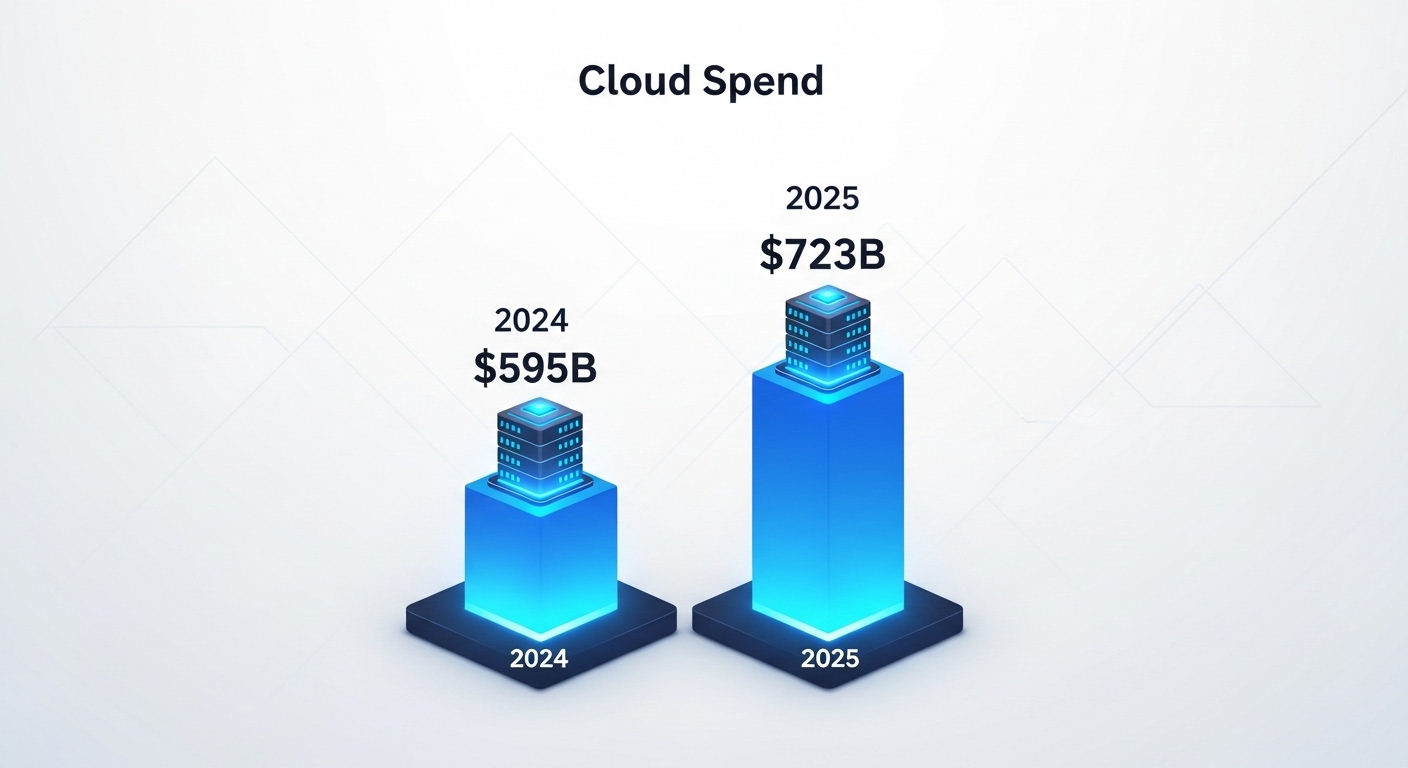
End-user spending on public cloud services worldwide is forecasted to total $723.4 billion in 2025, up from $595.7 billion in 2024. But here's what CTOs need to know: it's not just about migration anymore—it's about optimization.
Key Cloud Investment Areas:
1. Multi-Cloud Strategy (The New Default) 56% of respondents said they wanted the unique technological advantages that a specific cloud provider offered, while avoiding vendor lock-in. Azure Stack remains the most used private cloud platform, but smart CTOs are building hybrid architectures.
Investment Priorities:
- Cloud Cost Optimization Tools: Essential as 50% of respondents acknowledge that the pace of recent investments has left their organization with disconnected, piecemeal technology
- Container Orchestration: Kubernetes expertise and management platforms
- Edge Computing Infrastructure: For AI workloads requiring low latency
2. The AI-Cloud Connection
72% of organizations now utilize generative AI services, driving much of the cloud spending increase. The three hyperscalers—AWS, Microsoft Azure, and Google Cloud—are pouring tens of billions into AI infrastructure.
Strategic Insight: Don't just buy compute—invest in AI-optimized architectures. Public cloud platforms receive the largest share of AI budgets (11%) because they provide the scalability AI workloads demand.
Security: The Non-Negotiable Priority
The Threat Landscape Is Accelerating
The average number of cyberattacks per organization per week reached 1,636, a staggering 30% increase year over year. Meanwhile, deepfake fraud surged 3,000% in 2024 and now bypasses biometric authentication in 97% of attempts.
The Security Spending Surge:
- Global cyber spend to rise 15% in 2025
- Software now commands 40% of cybersecurity budgets in 2025
- Cloud security spending will reach $8.7 billion in 2025, up from $6.7 billion
Where to Invest Your Security Budget
1. AI-Powered Defense (The Arms Race)
Attackers are making the most of adversarial AI, with speed, stealth, and highly personalized target attacks becoming the most lethal. Your defense needs to match this pace.
Critical Investments:
- AI Security Platforms: Security platforms account for 9% of AI budgets, highlighting concerns around protecting AI systems
- Real-Time Threat Detection: Systems that can respond to attacks executing in milliseconds
- Behavioral Analytics: To catch AI-generated attacks that bypass traditional signatures
2. Cloud Security Architecture
Zero Trust Network Access (ZTNA) as one of their most significant planned cloud security investments in 2025 (48% versus 41% in 2024).
Investment Priorities:
- Cloud Access Security Brokers (CASB): Essential for multi-cloud environments
- Data Loss Prevention (DLP): Cloud data security and data loss prevention (38%)
- API Security: 37% prioritizing API security as microservices ecosystems expand
3. Post-Quantum Cryptography (The Future Is Now)
NIST's 2030 quantum deadline threatens retroactive decryption of $425 billion in currently protected data. This isn't a distant threat—it's a current planning imperative.
Action Items:
- Conduct cryptographic inventory of all systems
- Partner with cryptoagility providers
- Begin PQC implementation for high-sensitivity data
The CTO's Strategic Framework for 2025
1. Portfolio Approach to Technology Investment
Don't put all your eggs in one basket. Follow the 70-20-10 rule:
- 70% Core infrastructure and proven technologies
- 20% Emerging solutions with clear ROI paths
- 10% Experimental "moonshot" technologies
2. Data Infrastructure: The Foundation That Everyone Forgets
85% of leaders cite data quality as their most significant challenge in AI strategies for 2025. Yet only 36% of senior leaders say they're investing in data infrastructure fully and at scale.
Critical Investments:
- Data governance platforms
- Real-time data pipelines
- Data quality monitoring tools
- Master data management systems
3. Talent Strategy: The Make-or-Break Factor
54% of CEO respondents say they are hiring for roles related to AI that did not exist a year ago. Information security analyst roles are expected to grow 33%.
Key Hires for 2025:
- AI/ML Engineers with production experience
- Cloud Security Architects
- Data Engineers with real-time processing expertise
- DevSecOps specialists
Measuring Success: KPIs That Actually Matter
AI Investment Metrics
- Time to Value: Measure how quickly AI implementations show measurable impact
- Process Efficiency Gains: Percentage reduction in manual processing time
- Error Rate Reduction: Quality improvements in automated processes
- User Adoption Rate: Percentage of intended users actively using AI tools
Cloud Investment Metrics
- Cost per Workload: Total cloud spend divided by active workloads
- Resource Utilization: Percentage of provisioned resources actually used
- Migration Velocity: Applications successfully moved to cloud per quarter
- Service Reliability: Uptime and performance metrics
Security Investment Metrics
- Mean Time to Detection (MTTD): How quickly threats are identified
- Mean Time to Response (MTTR): Speed of threat containment
- Security Posture Score: Comprehensive risk assessment metrics
- Compliance Readiness: Percentage of systems meeting regulatory requirements

The ROCKPAPER RUNWAY Advantage: CTO Advisory Services
At ROCKPAPER RUNWAY, we understand that CTOs need more than vendor pitches—you need strategic guidance that balances innovation with pragmatic business outcomes. Our technology leadership advisory services help CTOs navigate the complex investment landscape while maximizing ROI and minimizing risk.
Our CTO Advisory Services Include:
- Technology Portfolio Assessment: Comprehensive evaluation of your current tech stack and investment opportunities
- AI Implementation Roadmaps: Practical strategies for deploying AI with measurable business outcomes
- Cloud Optimization Strategies: Multi-cloud architectures that reduce costs while improving performance
- Security Architecture Reviews: Future-ready security frameworks that protect against emerging threats
Ready to turn technology complexity into competitive advantage?
Contact ROCKPAPER RUNWAY for a confidential CTO strategic planning session tailored to your organization's unique challenges and opportunities.
FAQ: CTO Investment Strategy 2025
Q: Should I wait for AI costs to come down before investing? A: Morgan Stanley Research estimates that AI-driven productivity could add 30 basis points to 2025 net margins for members of the S&P 500. The cost of waiting likely exceeds the cost of investing now.
Q: How do I balance AI investment with existing IT priorities? A: Focus on AI applications that enhance current processes rather than replacing them entirely. 44% of organizations plan to invest in improving AI explainability, aiming to boost transparency and accountability.
Q: What's the biggest mistake CTOs make with cloud investments? A: 50% of respondents acknowledge that rapid investment has resulted in disconnected technology within their organization. Integration planning is as important as the technology itself.
Q: How urgent is the quantum computing threat? A: NIST finalized three critical Post-Quantum Cryptography standards in August 2024, mandating encryption algorithm retirement by 2030. Start planning now—implementation takes years.
Key Takeaways
- ✓There’s no one-size-fits-all QA strategy. Manual testing brings human insight, while automation delivers speed and scale. The most effective approach blends both, tailored to your team’s maturity, product stage, and budget.
- ✓💡 At ROCKPAPER RUNWAY, we partner with technical leaders to design QA strategies that drive quality, efficiency, and long-term ROI.

Discussion
Be the first to start the conversation.
Leave a Comment