
The Evolution of AI in Software Development
Copilot to Architect, How AI is Moving from Code Suggestion to System Design
Copilot to Architect, How AI is Moving from Code Suggestion to System Design
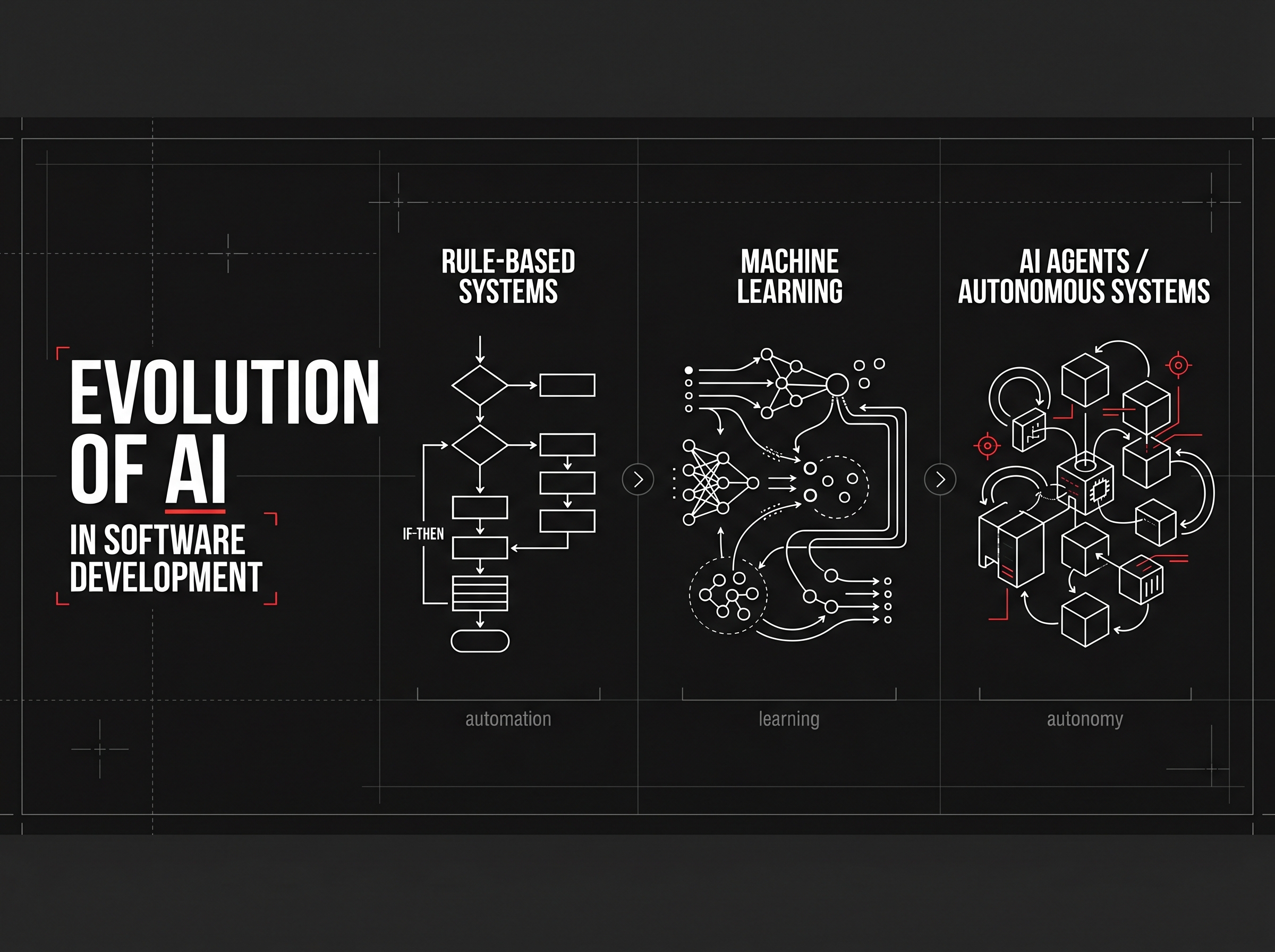
Artificial intelligence (AI) in software development has undergone a dramatic transformation in recent years. What began as a simple autocomplete feature has grown into something far more powerful. Today, tools like GitHub Copilot and ChatGPT are not just helping developers write snippets of code—they’re moving toward designing entire systems.
This shift from “Copilot” to “Architect” marks a profound change in how we think about building software. Instead of being just a coding assistant, AI is learning to shape system design, architecture, and workflows at scale.
The Evolution of AI in Software Development
From Auto-Complete to Code Suggestions
Early tools like IntelliSense provided predictive typing, reducing keystrokes but not really thinking beyond single functions.
Copilot and the Rise of Contextual Assistance
GitHub Copilot introduced the concept of AI-powered contextual understanding, analyzing not only what’s being typed but also the surrounding codebase. This paved the way for AI to “think” beyond lines of code and into broader system logic.
Why AI is Transitioning from Copilot to Architect
Increasing Complexity of Modern Systems
Software today involves distributed systems, cloud-native architectures, and microservices. Managing this complexity requires architectural thinking, not just coding skills.
Developer Demand for Higher-Level Abstractions
Developers don’t just want faster code—they want AI to help them make design decisions, enforce best practices, and anticipate trade-offs.
AI’s Expanding Contextual Understanding
With large language models (LLMs) now trained on architectural patterns, design blueprints, and best practices, AI can “see the bigger picture” rather than being limited to isolated code snippets.
Key Capabilities That Enable AI System Design
Architectural Pattern Recognition
AI can recognize when a project needs a monolithic approach vs. microservices, when to use CQRS, or when to scale with event-driven systems.
End-to-End Workflow Generation
Instead of just producing a function, AI can generate database schemas, API contracts, and deployment configurations.
Multi-Agent Collaboration in Design
AI agents can now collaborate—one specializing in frontend, another in infrastructure, and another in compliance—bringing system design closer to human-like architecture teams.
Real-World Use Cases of AI in System Architecture
- Cloud Infrastructure Blueprinting: AI tools can generate Terraform or AWS CloudFormation scripts aligned with architectural goals.
- API and Microservices Design: AI suggests microservice boundaries, API endpoints, and service orchestration strategies.
- Security and Compliance by Design: AI integrates compliance requirements (e.g., GDPR, HIPAA) into the architecture itself.
Challenges of AI as an Architect
- Balancing Creativity with Reliability: AI might suggest novel but untested architectures.
- Human Oversight and Trust: Architects must validate AI-generated designs to ensure they’re practical and secure.
- Ethical and Legal Implications: Questions around intellectual property and accountability emerge when AI designs systems.
The Future of AI in Software Architecture
- AI as a Co-Architect, Not a Replacement: Human expertise will remain vital, but AI will take over repetitive design tasks.
- Autonomous System Generation: AI may one day build full production-ready systems from a business description.
- Integration with DevOps and CI/CD Pipelines: AI will not only design but also continuously optimize system architecture in real-time.
Frequently Asked Questions (FAQs)
Q1. Can AI completely replace software architects?
No. AI enhances architects’ work but lacks deep domain understanding and business context that humans provide.
Q2. How is Copilot different from an AI Architect?
Copilot assists with code, while an AI Architect helps design entire systems, workflows, and integrations.
Q3. What risks exist in AI-driven architecture?
Over-reliance, lack of explainability, and potential security vulnerabilities are key risks.
Q4. Which industries benefit most from AI system design?
Finance, healthcare, and cloud-native startups benefit heavily due to complex compliance and scalability needs.
Q5. Will AI reduce the demand for software architects?
It will shift the role, making architects focus more on governance, validation, and business alignment.
Q6. How can developers prepare for AI-driven architecture?
By learning system thinking, validating AI output, and integrating AI tools into daily workflows.
Key Takeaways
- ✓The journey of AI in software development is evolving from code assistance to full system design. While Copilot started as a coding sidekick, the next generation of AI tools is stepping into the role of system architect. The future isn’t about replacing human architects but empowering them to design smarter, faster, and more resilient systems with AI as their creative partner.
- ✓👉 As AI continues to evolve, one thing is clear: the architect of tomorrow won’t be human or AI—it will be human and AI working together.


Discussion
Be the first to start the conversation.
Leave a Comment